Spaced Repetition for Students: Keep the Review Pile Small
Quit flashcards when the review pile hit 300? Here's how spaced repetition works, why missing 1 card in 10 is normal, and how to keep reviews short.
You tried a flashcard app once. The first week felt great. Then one morning it said 300 cards were due, and you closed it for good. Spaced repetition does work: you see each card again just before you'd forget it, and the gaps get longer every time you remember. The trick is keeping the daily pile small.
Here's why it works, how Strawberry Notes schedules your cards, and why getting about 1 card in 10 wrong means the schedule is doing its job.
Why does everything you crammed disappear a week later?
You know the routine. The test is Thursday, so on Wednesday night you go over your notes until they feel easy. Thursday goes fine. Then the final asks about the same chapter, and it's gone!
In 2006, Nicholas Cepeda and his colleagues pulled together 317 experiments from 184 articles on spreading study out (Cepeda et al., 2006). In 271 comparisons where people spent the same total time studying, splitting it into separate sessions beat doing it all at once: about 47% correct on the final test, against about 37%. Only 12 of the 271 showed no benefit from spacing.
The authors conclude that spreading learning across at least a day, rather than packing it into one session, is very useful for long-term memory. They also found that the right gap depends on when your test is: if it's next week, review again after a day or two, but if it's months away, wait longer between reviews.
Most of those studies tested word lists and word pairs, often over minutes rather than weeks, so the percentages aren't a promise about your grade. The same study time, spread out, beats the same time in one sitting.
What is spaced repetition, in plain words?
Spaced repetition is a schedule for your flashcards. Each time you remember a card, it waits longer before it comes back. Each time you forget, it comes back soon.
Here's a real example from the scheduler in Strawberry Notes. A new card you get right every time comes back after 10 minutes, then 2 days, then 11 days, then 46 days, then about 5 months. (The app adds a few days of random wiggle to the longer gaps.) Five answers, and you won't see that card again for months.
(To be fair, Cepeda's team said there wasn't enough data yet to tell whether growing gaps beat even ones. The app grows them because its memory model predicts that each right answer makes the memory last longer.)
Now the catch. Every new card you add books future reviews. Add 20 new cards today and, if you know them all, you've booked 20 reviews two days from now and 20 more about 11 days after that. Add 20 every day, and the bookings stack up.
How does Strawberry Notes decide when a card comes back?
Strawberry Notes schedules every card with FSRS, an open-source scheduler. For each card it estimates how long your memory of it will last and how hard the card is for you, and updates both with every answer. The next date is the day your chance of remembering the card is predicted to drop to your desired retention. That's a setting on each deck, and it starts at 90%.
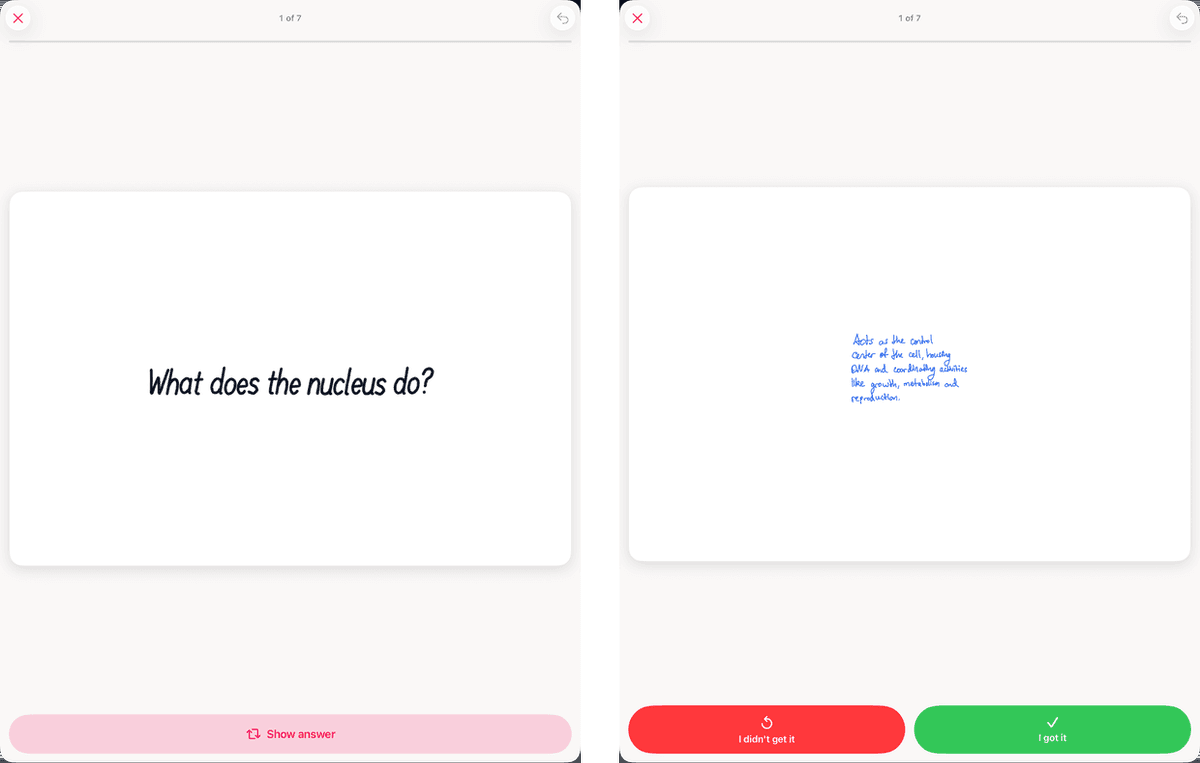
Tap a deck in the Flashcards tab, answer in your head, tap Show answer, and pick I didn't get it or I got it. Got it wrong? The card comes back within 10 minutes, usually before you've finished, and its gap starts small again.
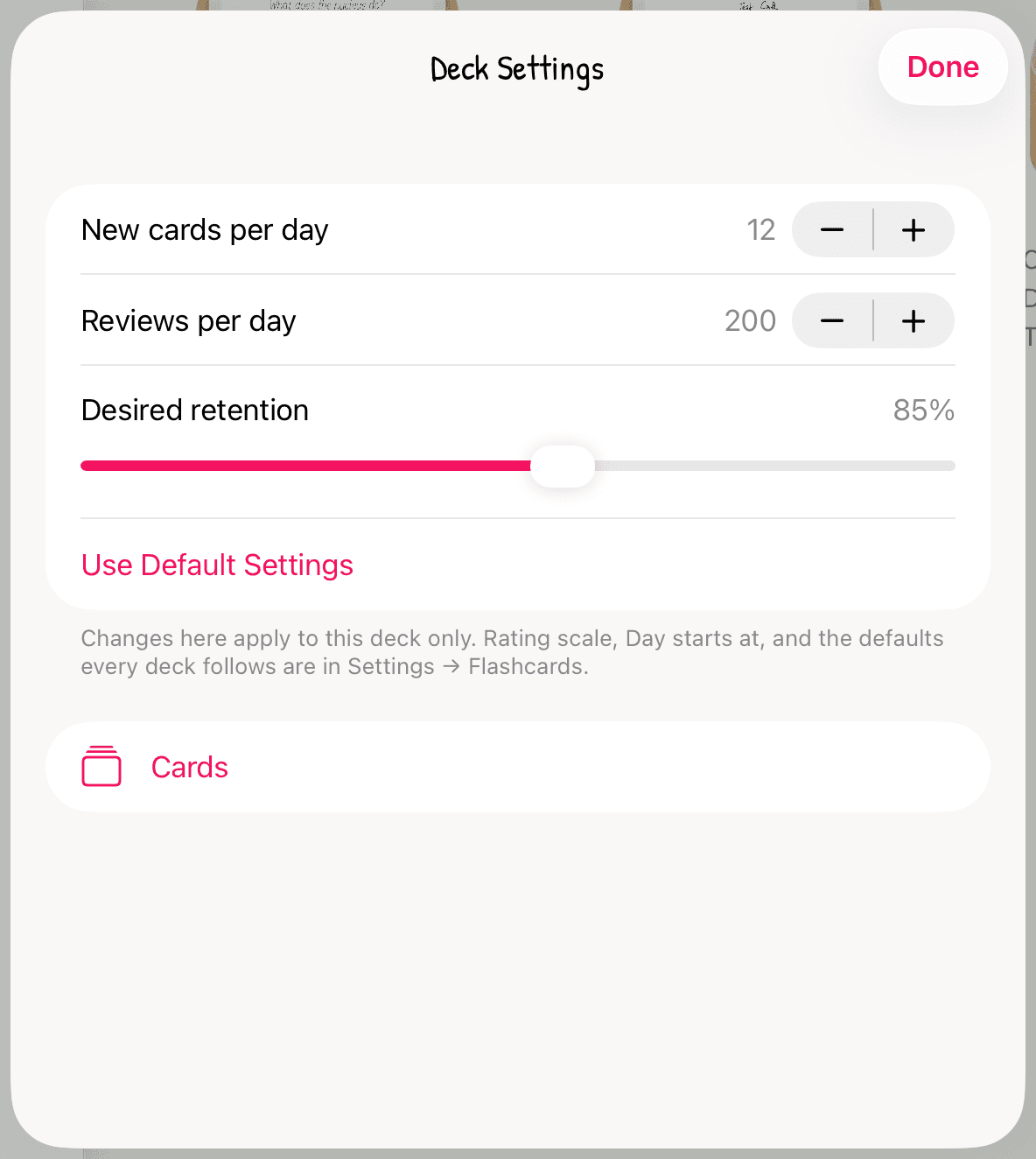
Long-press a deck and choose Deck Settings to change how that deck schedules:
- New cards per day: 20 to start.
- Reviews per day: a ceiling of 200 to start.
- Desired retention: 70% to 97%, and 90% to start.
- Day starts at: 4 AM to start. This one is in the app's Settings, under Flashcards, and it applies to every deck. That's when the daily limits reset, so a 1 a.m. session still counts as the day before.
You never pick dates. You answer honestly, and the deck does the rest.
Should you really get 1 in 10 cards wrong?
Here's the part that feels wrong at first.
At 90% desired retention, the app schedules each card for the day it predicts you have a 90% chance of remembering it. Not 100%. So across the cards you've already learned, expect to miss about 1 in 10. If you miss about 1 in 10 of your learned cards, the schedule is working.
Why not review sooner and get everything right? Because every extra percent costs reviews. Here's the same always-right card at three settings, from the app's scheduler (gaps after the first 10 minutes):
- 80%: 8 days, then 76 days.
- 90%: 2 days, 11 days, 46 days, then 163 days.
- 95%: 1 day, 3 days, 8 days, then 19 days.
Five answers in, that card is on a 19-day gap at 95% and a 163-day gap at 90%. Multiply that by every card in every class, and that's how a 300-card morning happens.
Going lower costs something too: at 80% you'd miss about 1 card in 5. And the misses aren't wasted. A miss tells the scheduler the card is harder for you than it thought, so it comes back more often until it sticks. What breaks the schedule is tapping I got it when you didn't. The card gets a longer gap it hasn't earned, and you'll probably miss it next time too.
You can check your own number. The scheduler starts from FSRS's standard settings, not ones fitted to you, so your real rate can drift from the target. Long-press a deck and open Stats. True retention is the share of reviews you got right on learned cards (brand-new cards in their first short steps don't count). If it sits near your desired retention, the deck is tuned. If it's well below, split cards that ask for too much at once. Here's how to make cards straight from your notes.
Which setting should you pick? 90% is a good place to stay. For a class you just need to pass, 85% roughly doubles the gaps. Before a big exam, you might nudge one deck up to 93% and accept more reviews. A change applies from each card's next answer; cards already scheduled keep their dates.
How do you keep the daily pile small?
A small pile is one you'll actually open tomorrow:
- Lower New cards per day when you're busy. New cards are the part of tomorrow's pile you control. Try 5 or 10 in a heavy week; the deck's To learn count drops to match.
- Study a little every day. One day's reviews are a short sitting. A week's are a pile.
- Make fewer, better cards. One idea per card, and a question that asks for something specific.
- Turn on the reminder. In the app's settings, under Flashcards, switch on Daily flashcard reminder and pick a time. You get one notification a day with the number of cards due, and none when you're caught up.
- Grade honestly, even when it stings.
Exam tomorrow and you want one more pass? When a sitting ends, tap Practice Again to run through the whole deck. Practice doesn't change your review schedule, so a last-minute cram won't throw your dates off.
What if you're already 300 cards behind?
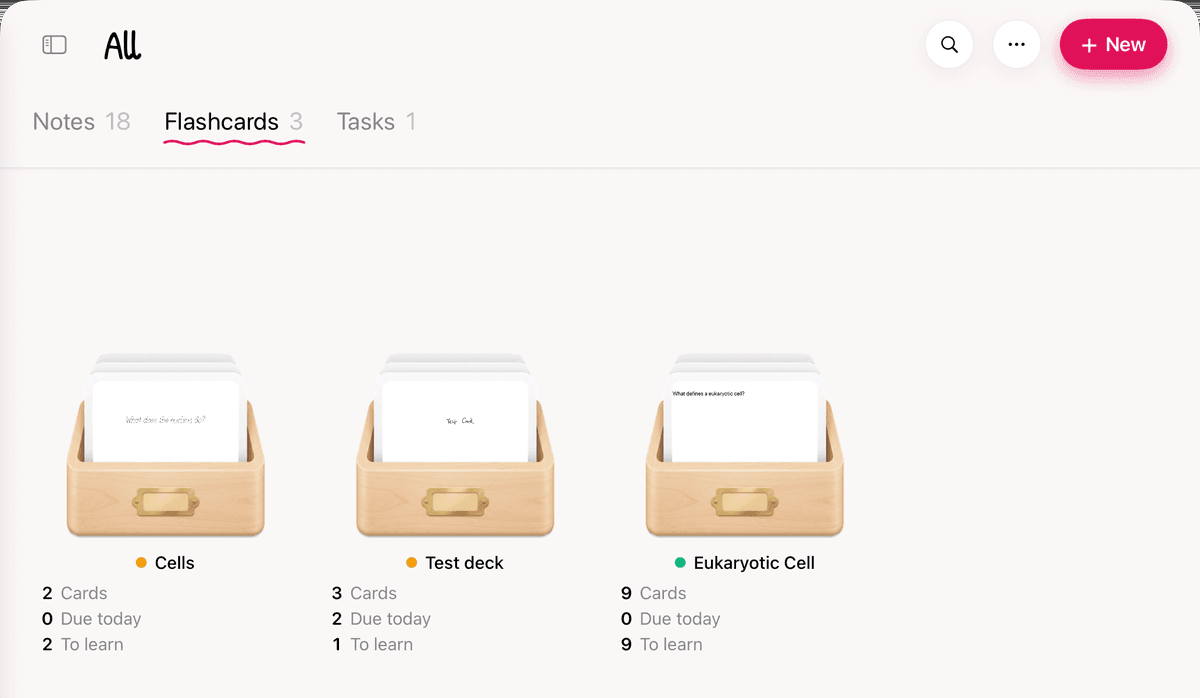
Say you skipped a week and hundreds of cards are overdue. The app caps a day's reviews at 200 by default (Reviews per day), so the rest wait their turn. Don't delete the deck.
- Set New cards per day to 0 in Deck Settings. Nothing new joins the pile while you dig out.
- Do one sitting a day. Overdue cards come first, longest-waiting first. If 200 is too many, lower Reviews per day.
- Answer honestly. Cards you still remember after a long wait get pushed even further out. In the app's test data, a card due after 11 days but answered right after 30 got a 77-day gap, against 46 days when answered on time.
- Turn new cards back on slowly once Due today fits in one sitting again.
Why testing yourself beats reading your notes again: active recall vs rereading.
Sources
- Cepeda, N. J., Pashler, H., Vul, E., Wixted, J. T., & Rohrer, D. (2006). Distributed practice in verbal recall tasks: A review and quantitative synthesis. Psychological Bulletin, 132(3), 354–380.