Interleaving Study Method: Mix Topics to Remember More
Did 20 problems of one type, aced them, then froze on the test? The interleaving study method fixes that. Here's how to mix your practice.
You did twenty problems of the same type and got every one right. Then the test mixed everything up, and you froze: which method do I use here? Interleaving fixes that. Instead of practicing one topic at a time, you mix several problem types in one session, so you learn to pick the method yourself.
It feels harder and messier. That's the point!
What is the interleaving study method?
Blocked practice looks like this: AAAA BBBB CCCC. All the addition, then all the subtraction, then all the multiplication. Interleaved practice looks like this: ABC ABC ABC.
Why does it matter? When every problem in a row is the same type, you already know the method before you read the question. You're just repeating it. On a test, nobody tells you which method to use. Interleaving trains that exact skill: look at the problem, decide what kind it is, then solve it.
Does interleaved practice work?
It looks like it does, and it often feels like it doesn't.
The Retrieval Practice site describes a study by Taylor and Rohrer (2010) with fourth-grade math students. One day later, the interleaved group scored 77% on the exam and the blocked group scored 38%. The same page says the interleaved students did worse at the end of practice itself. The practice felt harder, and it still paid off.
Kornell and Bjork (2008) found the same thing with art. UCLA students studied paintings by 12 artists, either six in a row from one artist or mixed in with the others. Then they had to say who painted new paintings. 78% of them did better with the mixed paintings. And 78% said that studying one artist at a time was as good or better.
So if your practice feels harder and slower, that's normal. It doesn't mean it isn't working.
How do you use interleaved practice?
- Learn each topic first. Interleaving is for practice. Understand each type on its own, then mix.
- Pick 2 to 4 related types. Ones that look alike are best, like the four rules for derivatives, or mitosis vs. meiosis. Don't mix your whole course.
- Shuffle them. One problem of each type, in a random order. No two of the same type back to back.
- Check your mistakes. Look at each wrong answer and ask: did I pick the wrong method, or did I do the right method wrong? Wrong method means you mix those two up. That's the one to practice.
It's not only for math. In biology, mix questions about mitosis, meiosis and osmosis. In chemistry, mix acid-base, redox and stoichiometry problems. In a language, mix past-tense and present-tense sentences.
How to do it in Strawberry Notes
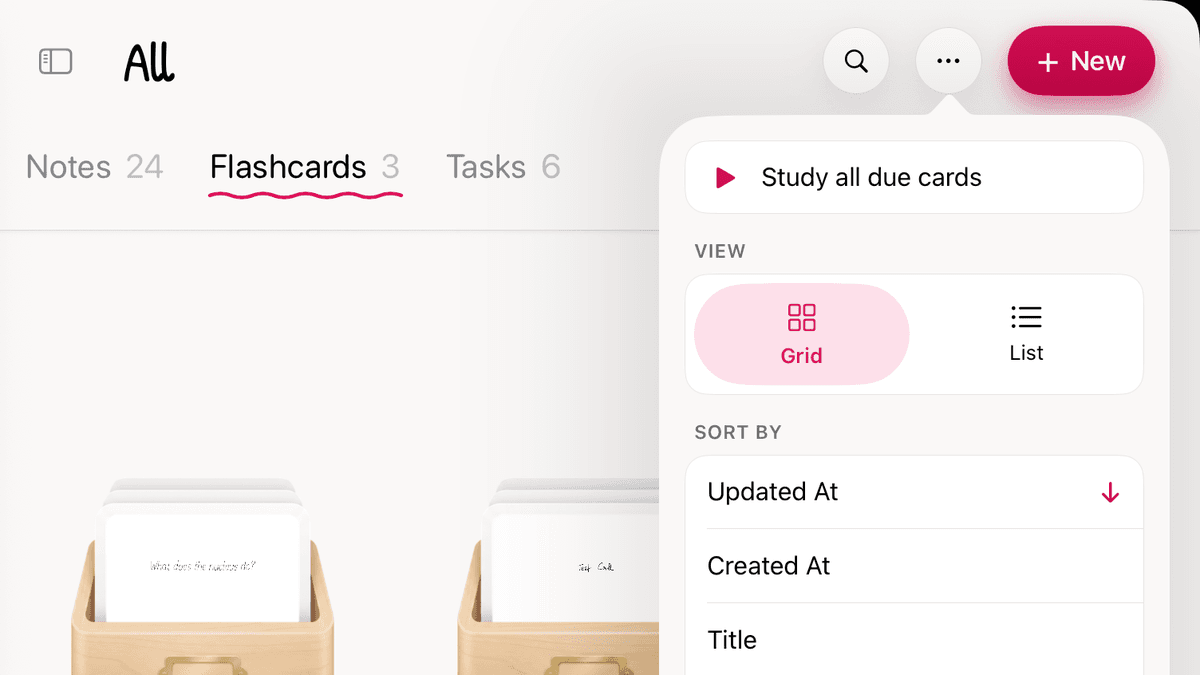
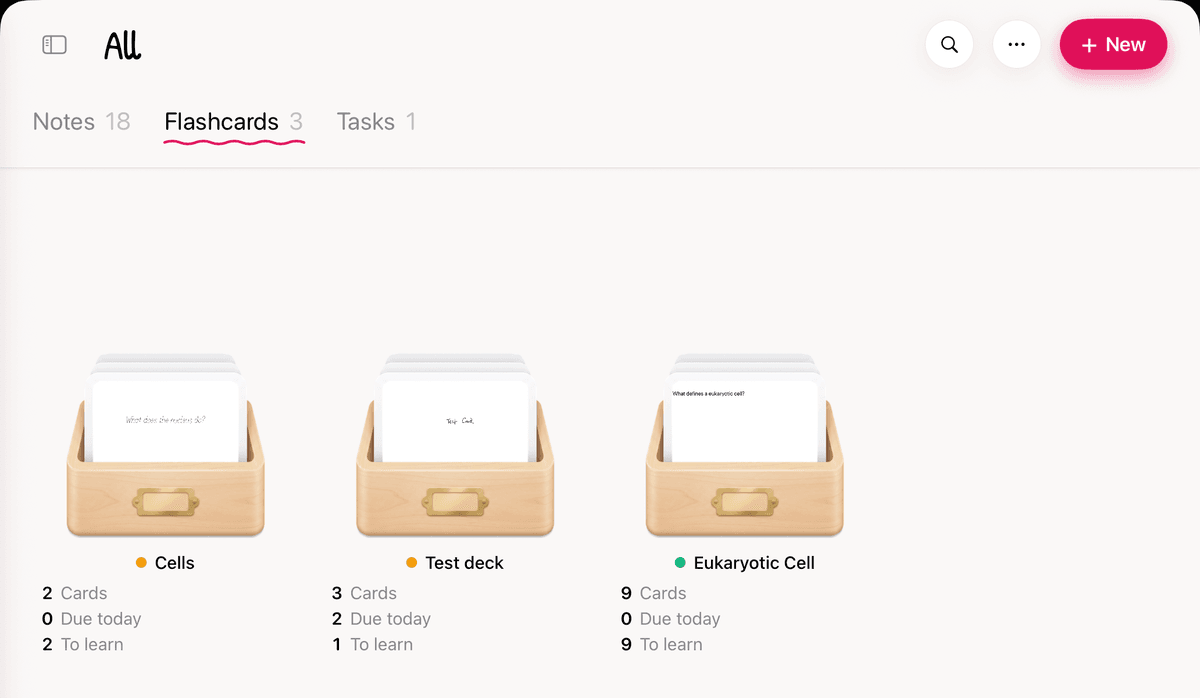
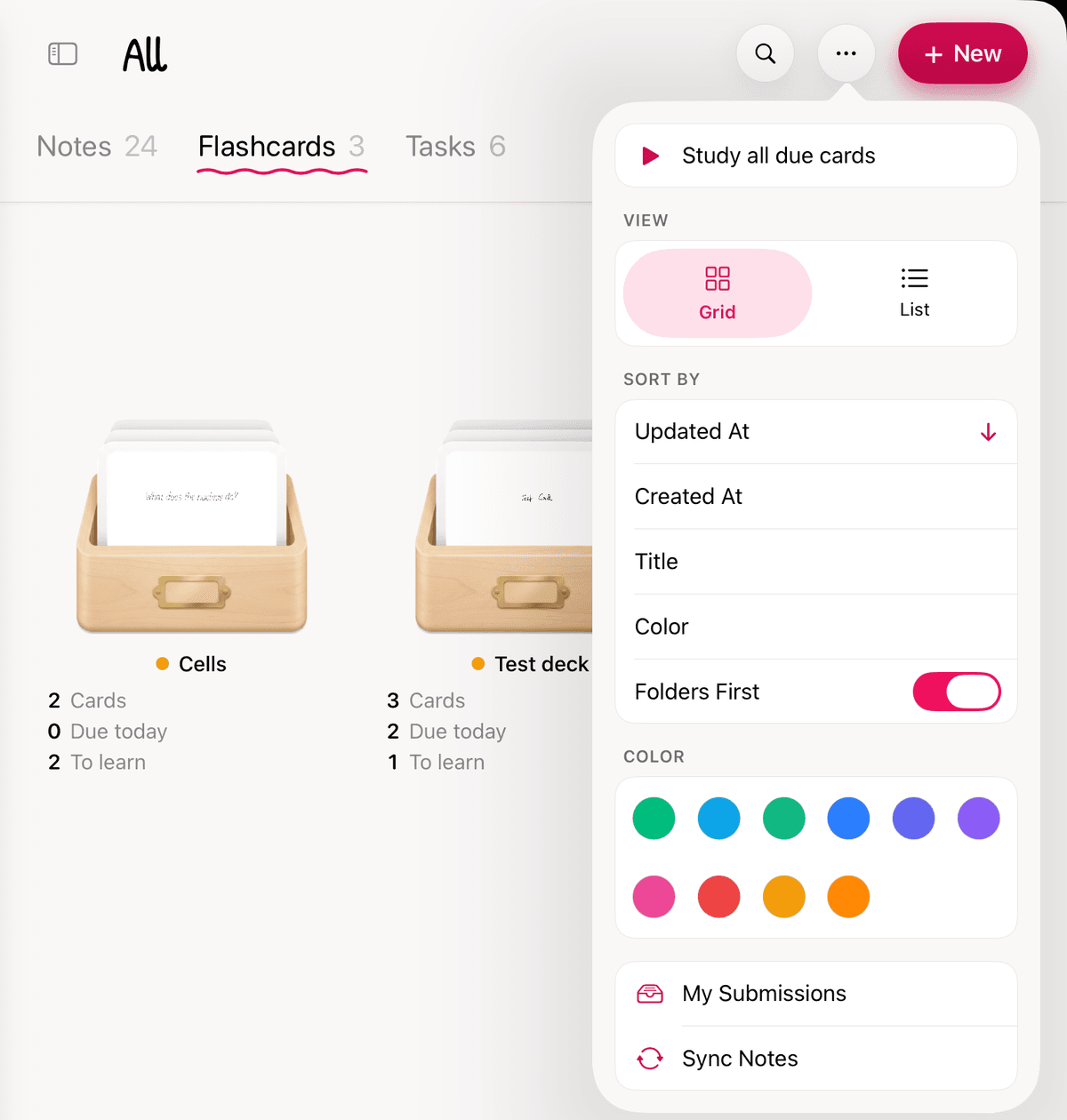
Flashcards: Study all due cards. Keep one deck per topic as usual. Then go to the Flashcards tab, tap •••, and choose Study all due cards. It studies every deck with cards due in one sitting, taking one card from each deck in turn. Your topics get mixed for you.
Practice sheet: Open a Whiteboard and write one problem of each type, in a shuffled order. Cover the answers with the Tape tool, work through them, and peel the tape to check.
Quiz: If you use the AI ("Quiz me on this" on a note, optional, uses credits), the quiz has a Shuffle questions switch. Turn it on.
Studying for a math test? Here's how to study for a math test.
Interleaving vs. spaced repetition
They're different, and they work well together. Spacing is about when: you come back to a topic after a gap. Interleaving is about what order: you mix topics inside a session. In the paintings study above, the mixed paintings were also spread out in time, so the two ideas overlap. Either way, a mixed deck that comes back on a schedule uses both. More on spacing: spaced repetition for students.